
The following is a repost from www.oil-price.net:
"Oil price and the $700B bailout by Steve Austin - 2008/10/06
As the US house of representatives voted to increase the dollar supply by $700B, many are wondering what effect this will have on energy prices.
History is full of tragic examples where helicopter money triggered rampant inflation and widespread economic hardship. Let's take a look at some of these examples in the light of today:
Crushed by World War One's debt, the Weimar republic kept printing money and giving it directly to consumers and businesses to buy votes and help them cope with ever increasing prices.
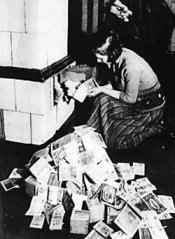
Within a few years the Mark had devaluated so much that a postage stamp cost fifty billion Mark and everyone's life savings had been wiped out. Mark bills were worth less than the paper they were printed on. As the famous picture above illustrates, in the face of galloping energy prices, it had become cheaper to heat one's house by burning money than coal. Although one US dollar is still worth more than the paper it is printed on, as of 2008 one US penny contains 2 cents worth of metal. Although oil prices seem high today, they are kept artificially low because many oil-producing nations such as Saudi Arabia peg their currencies to the US dollar. When the dollar is devaluated, these countries currencies and national economies are threatened by inflation and this is an incentive for them to let their currencies float and appreciate. In 2006 Kuwait unpegged its currency from the US dollar and as other oil-producing nations follow suit, expect energy prices to rise. Currently oil is bought and sold on the world market in dollars, so everyone needs to first buy dollars in order to buy oil. We have reported on a trend for oil-producing countries to sell oil in Euros instead of Dollars. As more oil-producing nations fear the dollar is becoming "funny money" and demand payment in Euros, the world's need for Dollars will be greatly reduced. This is basic supply/demand economics. Simply put, the average American household is already too much in debt and this scares banks from lending any money. Giving $700B to these banks will not change the fact that lending to bad debtors is a risky venture. It is safer for banks to invest this money in commodities (oil and gold) which do keep up with inflation than to issue loans that cannot be repaid. So expect this bailout package to give a speculative boost to oil prices."
Now as stated banks have "invested" TARP funds into commodities (specifically oil and gold) in order to make a return on investment for dollars. Interesting issue here is the people giving them the money to "invest" are the same people they are profiting from. Intrinsically, this is wrong since a free market works best when a supplier and a user act together in a unrestricted (relatively) manner and without others corrupting the market. What has happened over the last five-ten years is that more speculators are playing in the market than actual users of the goods. Lets look at the chart above, long boxes indicate a wide trading range showing large "activity". In November 2008 you will notice a long red box. This box indicates a large drop in oil price. Remember what happened in November? Banks where failing and calling in "assets and leveraged positions". For several months the banking institutions did not play in the market as a buyer or speculator in oil futures. So without the banks speculating (taking a few cents on the dollar risk to "buy" a position, only to sell it to another bank, then to another, inflating the price of the commodity which they know at the end of the month an actual user will have to buy the commodity for actual use. End result, artificially inflated oil which is purchased by a refiner and then a wholesaler, then a retailer and then the consumer (US citizen).
Now lets look at the months of January and February 2009. In these months the banking industry did not have the funds to play into the market and as such the price of oil was driven only by true "market factors" (in other words how much we actually used). Notice that the spread in the chart is very narrow as the "speculators" where removed from the market and only actual users of the oil (the production companies) purchased or held oil. Now once TARP funds where truly out an into investments (it takes a bank typically 30-60 days to move capital into investment arms) the spread increases rather dramatically and the resultant speculation increases our costs of fuel at the pump ... which in turn drives the cost of everything we use up.
Truly, the speculation in commodities by non-users needs to be regulated and the cost of "buying a position" needs to be increased, probably to the point where a position costs 80% (full cash) of the total contract instead of the 10-15% range (on credit) that exists today. It is wrong for a bank to take tax payer dollars and then rob the tax payer by open market speculation. All arguments presented in defense of these tactics are rhetorical, incorrect and frankly fraudulent.
As stated before, the meltdown in our economy came from the dramatic drop in cash the average consumer had in hand each month. The current surge in unemployment, homelessness and wage reduction will only be made worse by speculation of the large banks in oil. Demand your congressman to stop "non-user speculation" and raise the cost of speculative trading.
Here at "When do you resist" we ask the question "When the system becomes more than the people. What do you do to change it and when?"
"Oil price and the $700B bailout by Steve Austin - 2008/10/06
As the US house of representatives voted to increase the dollar supply by $700B, many are wondering what effect this will have on energy prices.
History is full of tragic examples where helicopter money triggered rampant inflation and widespread economic hardship. Let's take a look at some of these examples in the light of today:
Now as stated banks have "invested" TARP funds into commodities (specifically oil and gold) in order to make a return on investment for dollars. Interesting issue here is the people giving them the money to "invest" are the same people they are profiting from. Intrinsically, this is wrong since a free market works best when a supplier and a user act together in a unrestricted (relatively) manner and without others corrupting the market. What has happened over the last five-ten years is that more speculators are playing in the market than actual users of the goods. Lets look at the chart above, long boxes indicate a wide trading range showing large "activity". In November 2008 you will notice a long red box. This box indicates a large drop in oil price. Remember what happened in November? Banks where failing and calling in "assets and leveraged positions". For several months the banking institutions did not play in the market as a buyer or speculator in oil futures. So without the banks speculating (taking a few cents on the dollar risk to "buy" a position, only to sell it to another bank, then to another, inflating the price of the commodity which they know at the end of the month an actual user will have to buy the commodity for actual use. End result, artificially inflated oil which is purchased by a refiner and then a wholesaler, then a retailer and then the consumer (US citizen).
Now lets look at the months of January and February 2009. In these months the banking industry did not have the funds to play into the market and as such the price of oil was driven only by true "market factors" (in other words how much we actually used). Notice that the spread in the chart is very narrow as the "speculators" where removed from the market and only actual users of the oil (the production companies) purchased or held oil. Now once TARP funds where truly out an into investments (it takes a bank typically 30-60 days to move capital into investment arms) the spread increases rather dramatically and the resultant speculation increases our costs of fuel at the pump ... which in turn drives the cost of everything we use up.
Truly, the speculation in commodities by non-users needs to be regulated and the cost of "buying a position" needs to be increased, probably to the point where a position costs 80% (full cash) of the total contract instead of the 10-15% range (on credit) that exists today. It is wrong for a bank to take tax payer dollars and then rob the tax payer by open market speculation. All arguments presented in defense of these tactics are rhetorical, incorrect and frankly fraudulent.
As stated before, the meltdown in our economy came from the dramatic drop in cash the average consumer had in hand each month. The current surge in unemployment, homelessness and wage reduction will only be made worse by speculation of the large banks in oil. Demand your congressman to stop "non-user speculation" and raise the cost of speculative trading.
Here at "When do you resist" we ask the question "When the system becomes more than the people. What do you do to change it and when?"


No comments:
Post a Comment